Myrtle Beach property tax on a second home or rental: South Carolina’s 4% and 6% rates
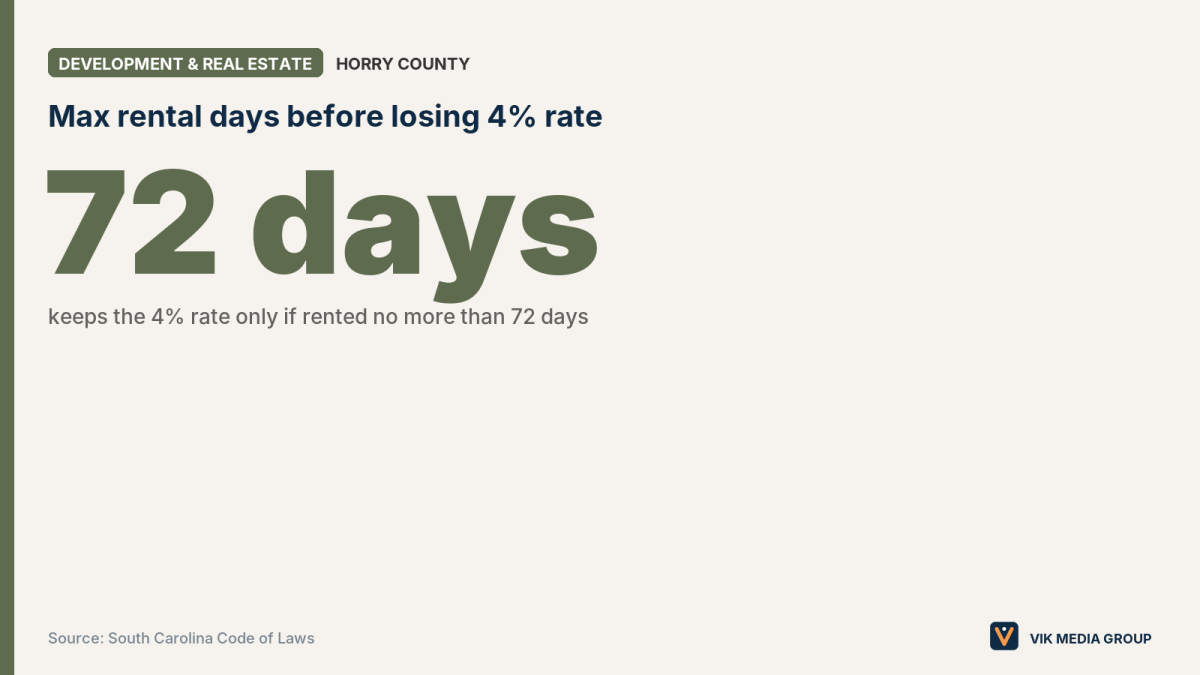
South Carolina assesses an owner-occupied legal residence at 4% of its fair market value and most other real property, including second homes and rental properties, at 6%, under Section 12-43-220 of the South Carolina Code of Laws. The 4% rate requires the owner to live in the home as a domicile, apply on time and not rent it out for more than 72 days in a calendar year, as of Oct. 31, 2026.
The difference is large: at the same fair market value and millage, 6% produces an assessed value 50% higher than 4%. The 4% rate “only applies to primary residences, not second/vacation homes,” according to the Horry County Assessor’s Office.
What are South Carolina’s 4% and 6% assessment ratios?
An assessment ratio is the share of a property’s fair market value that is taxed. The county multiplies the assessed value by the local millage to get the bill.
| Property | Assessment ratio | Law |
|---|---|---|
| Owner-occupied legal residence, plus up to five contiguous acres | 4% | S.C. Code Section 12-43-220(c)(1) |
| Real property not otherwise classified, including second homes and rentals | 6% | S.C. Code Section 12-43-220(e) |
| Legal residence with no timely application | 6% | Section 12-43-220(c)(2)(ii) |
Source: S.C. Code of Laws, Title 12, Chapter 43, checked Oct. 31, 2026.
How much more is a 6% assessment?
An example by this newsroom using the two ratios: on a home with a fair market value of $400,000, the assessed value is $16,000 at 4% and $24,000 at 6%. The owner pays the same millage on $8,000 more of assessed value.
The legal residence also comes with a credit against school operating taxes, according to the Horry County Assessor’s guide to assessment. A second home or rental at 6% does not get that credit, so the gap on the final bill can be larger than the ratio alone suggests.
Can I rent out my legal residence and keep the 4% rate?
Only for a limited time. Section 12-43-220(c)(2)(iv) says the residence qualifies only if it is not rented for more than “seventy-two days in a calendar year.” Rent it for more than 72 days in a year and it no longer meets the legal residence test, so it falls to 6%.
The other conditions, under Section 12-43-220(c)(2):
- Ownership and domicile: the owner must have owned the home and lived in it as a legal residence, domiciled there, for some part of the tax year.
- Application: the owner must apply before the first penalty date for taxes in the first year the owner claims the rate.
- Vacation homes: the legal residence “shall not include a residence maintained principally for vacation or recreational purposes,” according to the Horry County Assessor’s guide.
When is the 4% application due in Horry County?
The application is due before the first penalty date for the tax year. For tax year 2024, the Horry County Assessor’s guide says to file between Jan. 1, 2024, and Jan. 15, 2025. Once approved, the owner does not need to reapply unless the residence changes. Owners given provisional or conditional approval in 2025 had until May 31, 2025, to finish the application, according to a county notice posted April 30, 2025.
How do reassessments affect a Grand Strand rental?
South Carolina counties reappraise property every five years under Section 12-43-217, according to the Horry County Assessor’s guide. The increase in fair market value from a reassessment is capped at 15% over a five-year period under Section 12-37-3140. The cap does not apply to new additions or improvements, or to a property in the year it has an assessable transfer of interest, such as a sale.
After a reassessment, the millage is generally rolled back so total revenue does not rise just because values went up, the guide says.
What does this mean for Myrtle Beach and Grand Strand investors?
A condo or house bought as a vacation rental is assessed at 6% from the start. An owner who moves to the Grand Strand and later rents the home for more than 72 days a year loses the 4% rate. Tell the assessor when the use of a property changes.
Across the state line, Brunswick County, N.C., does not use South Carolina’s assessment ratios; ask the Brunswick County tax office how a rental is taxed there.
Who do I call about property tax on the Grand Strand?
- Horry County Assessor’s Office: 843-915-5040, [email protected], 1301 Second Ave., Suite 1C08, Conway
- Georgetown County: the county assessor’s office
- S.C. Department of Revenue, property tax policy: dor.sc.gov
Own a rental here? Tell us what the rules mean in practice: email our newsroom through the Contact link at the bottom of this page.
This story is information, not financial or legal advice.
More Finance & Taxes guides and local services ›
Live in the Grand Strand? Write for us as a Community Contributor and share what you see in your town.
Questions and answers
- What is the property tax rate on a second home in South Carolina?
- Second homes and rentals are assessed at 6% of fair market value under S.C. Code Section 12-43-220(e). An owner-occupied legal residence is assessed at 4%.
- How many days can I rent my primary residence in South Carolina and keep the 4% rate?
- No more than 72 days in a calendar year, under S.C. Code Section 12-43-220(c)(2)(iv).
- How do I get the 4% property tax rate in Horry County?
- Apply to the Horry County Assessor before the first penalty date for the tax year, usually Jan. 15 of the following year. You must own the home and live in it as your domicile. Call 843-915-5040.
- Is there a cap on property value increases in South Carolina?
- Under Section 12-37-3140, the value increase from a reassessment is capped at 15% over five years, except for improvements or a sale, according to the Horry County Assessor.