Horry County reassessment: every fifth year, with a 15% cap on value increases
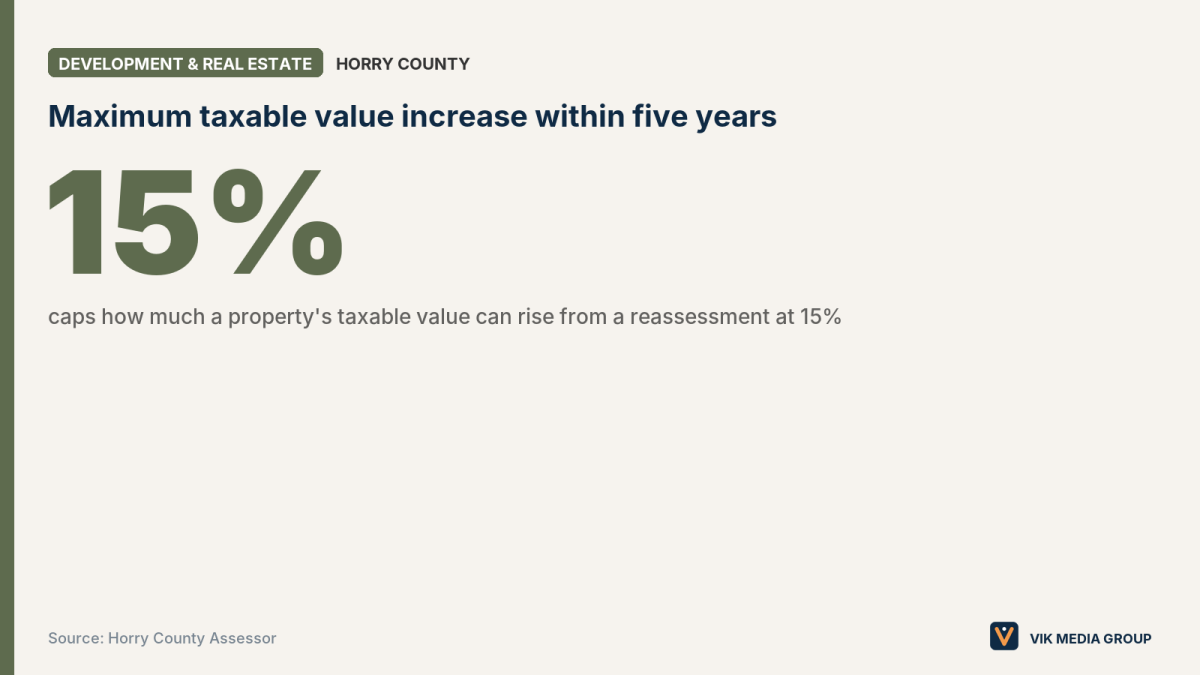
Horry County reassesses property every fifth year under S.C. Code 12-43-217, according to the Horry County Assessor’s guide to assessment. State law, Section 12-37-3140, caps how much a property’s taxable value can rise from a reassessment at 15% within five years, the same guide says. For owners of second homes and rentals on the Grand Strand, those two rules set the pace and the limit on how fast the value behind a tax bill can climb.
How often does Horry County reassess property?
Every fifth year. The Assessor’s guide cites S.C. Code 12-43-217 for the five-year cycle. In plain terms, values are reset countywide on that schedule, not every year. A reassessment does not happen when you buy, and it does not happen because a neighbor’s house sold for a lot more than yours.
For owners of second homes and rentals, the practical point is timing. Any change in your property’s taxable value from a reassessment shows up in a reassessment year, not in the years between.
How does the 15% cap work?
The cap limits the increase in a property’s taxable value from reassessment to 15% over five years. The Assessor’s guide cites S.C. Code 12-37-3140 for the rule. It applies even if market values rose by more than 15% over the same period.
The cap is about the value, not the tax rate. It does not set what your bill will be, because the bill also depends on the assessment ratio and on local millage rates.
Why does the 4% vs. 6% ratio still matter?
The cap limits how far the value can rise. The assessment ratio is a separate piece of the math, and it can matter just as much to an owner.
Under S.C. Code 12-43-220, a legal residence, plus up to 5 acres, is assessed at 4% under subsection (c)(1). Other property is assessed at 6% under subsection (e). The Horry County Assessor says the 4% rate excludes vacation homes.
Two more details from the statute:
- A home that qualifies for the 4% rate cannot be rented for more than 72 days in a calendar year, under (c)(2)(iv).
- Owners must apply for the 4% rate before the first penalty date.
Our Nov. 4 story on Myrtle Beach property tax on a second home or rental covers the 4% and 6% rates in more detail.
Does a second home or rental get the school operating tax credit?
The Assessor’s guide says the school operating tax credit applies to a legal residence. A second home or rental taxed at 6% is not a legal residence, so the credit does not apply to it, as the guide states.
What should Horry County owners do now?
Here is a short checklist built from the county and state rules:
- Remember the cycle. Horry County reassesses every fifth year under S.C. Code 12-43-217.
- Remember the limit. Under S.C. Code 12-37-3140, taxable value can rise no more than 15% from reassessment within five years.
- Check your classification. Find out whether your property is taxed at 4% as a legal residence or at 6% as other property.
- If the property is your legal residence, apply for the 4% rate before the first penalty date.
- If you rent your 4% home, keep the rental to 72 days or fewer in a calendar year.
Questions about your own property go to the Horry County Assessor at 843-915-5040.
This story is information, not financial or legal advice.
More Legal guides and local services ›
Share or cite this page
Horry County reassessment: every fifth year, with a 15% cap on value increases. Grand Strand Dispatch, November 11, 2026. https://grandstranddispatch.com/horry-county/2026/11/horry-county-reassessment-15-percent-cap/
<a href="https://grandstranddispatch.com/horry-county/2026/11/horry-county-reassessment-15-percent-cap/">Horry County reassessment: every fifth year, with a 15% cap on value increases</a>
Grand Strand Dispatch. (2026, November 11). Horry County reassessment: every fifth year, with a 15% cap on value increases. https://grandstranddispatch.com/horry-county/2026/11/horry-county-reassessment-15-percent-cap/
Free to share or quote with credit and a link.
Questions and answers
- How often does Horry County reassess property?
- Every fifth year. The Horry County Assessor's guide cites S.C. Code 12-43-217 for the five-year reassessment cycle.
- What is the 15% cap on property value increases in Horry County?
- Under S.C. Code 12-37-3140, as cited by the Horry County Assessor, the increase in a property's taxable value from reassessment is limited to 15% within five years.
- Does the 4% property tax rate apply to a vacation home in Horry County?
- No. The Horry County Assessor says the 4% rate excludes vacation homes. State law gives the 4% ratio to a legal residence plus up to 5 acres, and other property is assessed at 6%.
- How many days can I rent my home and still qualify for the 4% rate?
- Under S.C. Code 12-43-220(c)(2)(iv), a home that qualifies for the 4% ratio cannot be rented for more than 72 days in a calendar year.
- Do second homes in Horry County get the school operating tax credit?
- The Horry County Assessor's guide says the credit applies to a legal residence, so a second home or rental taxed at 6% does not get it.