NC DEQ Tells Chemours to Fix Gaps in Its Plan to Clean Up PFAS Contamination
The NC Department of Environmental Quality says Chemours' plan to clean up PFAS groundwater contamination in southeastern North Carolina has significant gaps.
Chemours PFAS SettlementPart of a story we are following · 1 article · See every update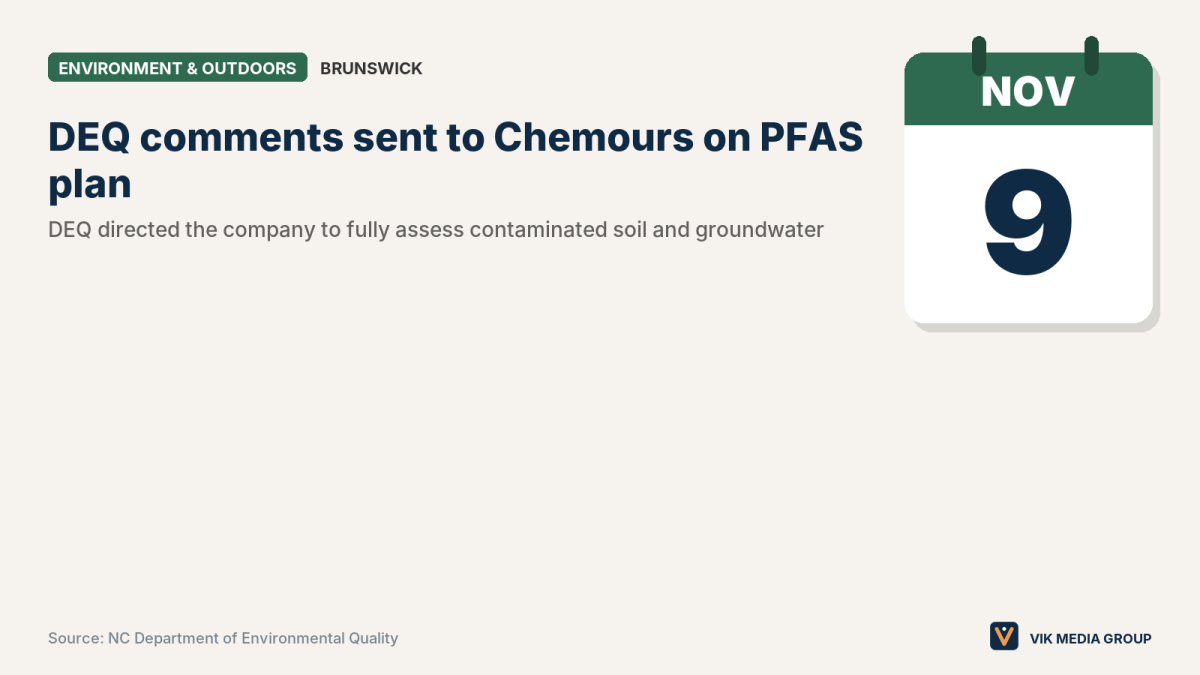
The North Carolina Department of Environmental Quality (DEQ) says Chemours has not met its obligations to address PFAS, or “forever chemicals,” in groundwater across southeastern North Carolina. In comments sent to the company on Nov. 9, 2026, DEQ detailed problems in Chemours’ On and Offsite Assessment and Corrective Action Plan.
What DEQ ordered Chemours to do
DEQ directed Chemours to:
- Fully assess contaminated soil and groundwater throughout the Lower Cape Fear region, and any associated risks to human health and the environment.
- Revise its corrective action plan to restore contaminated groundwater, as required by state law.
- Expand the plan to include all PFAS associated with the facility, not just a limited subset of contaminants.
- Evaluate how remaining emissions from the facility affect groundwater, and develop a plan to address those impacts.
The release does not give a deadline for Chemours to respond.
How much Chemours has spent
Chemours has spent approximately $1.2 billion on compliance with the 2019 Consent Order, according to DEQ. The agency said the company still has not finished assessing how far PFAS contamination has spread and has not submitted an adequate plan to address it.
Work done since the Consent Order
DEQ listed several steps Chemours has taken since the Consent Order was finalized. The company stopped discharging highly contaminated wastewater from the Fayetteville Works plant. It built a subsurface barrier wall more than a mile long and a treatment system to keep PFAS from migrating into the Cape Fear River. It also sampled about 27,500 wells belonging to southeastern North Carolina households for PFAS, and offered filtration systems to about 10,500 families whose wells are contaminated.
DEQ said the directive is a major step in a process set out in a September 2026 settlement among Chemours, North Carolina, 11 counties and municipal water systems. In a separate action, DEQ’s Division of Air Quality sent Chemours a letter raising concerns about data collection, lab analysis and transparency regarding air emissions from the Fayetteville Works facility. The letter lists actions the company must take immediately.
Share or cite this page
NC DEQ Tells Chemours to Fix Gaps in Its Plan to Clean Up PFAS Contamination. Grand Strand Dispatch, November 9, 2026. https://grandstranddispatch.com/brunswick-county/2026/11/nc-deq-tells-chemours-fix-gaps-pfas-cleanup/
<a href="https://grandstranddispatch.com/brunswick-county/2026/11/nc-deq-tells-chemours-fix-gaps-pfas-cleanup/">NC DEQ Tells Chemours to Fix Gaps in Its Plan to Clean Up PFAS Contamination</a>
Grand Strand Dispatch. (2026, November 9). NC DEQ Tells Chemours to Fix Gaps in Its Plan to Clean Up PFAS Contamination. https://grandstranddispatch.com/brunswick-county/2026/11/nc-deq-tells-chemours-fix-gaps-pfas-cleanup/
Free to share or quote with credit and a link.
Questions and answers
- How much has Chemours spent on the 2019 Consent Order?
- According to the NC Department of Environmental Quality's Nov. 9, 2026 press release, Chemours has spent approximately $1.2 billion on compliance with the 2019 Consent Order. The agency said the company still has not finished assessing the extent of PFAS contamination.
- What did NC DEQ order Chemours to do about PFAS contamination?
- On Nov. 9, 2026, DEQ directed Chemours to fully assess contaminated soil and groundwater in the Lower Cape Fear region, revise its corrective action plan, expand the plan to all PFAS associated with the facility, and evaluate how remaining emissions affect groundwater.